28 APRIL 2015
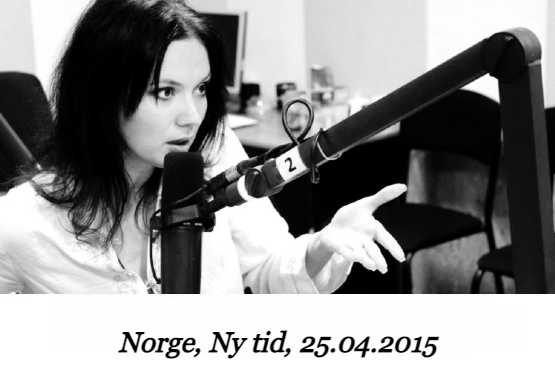
Press freedom in Ukraine is threatened by several teams. «Some of the worst is self-censorship,» says Ukrainian journalist Anna Stepanets. This month she visited Oslo.
(THIS ARTICLE IS MACHINE TRANSLATED by Google from Norwegian)
The international press organization Reporters Without Borders places Ukraine at the 127th place out of a total of 180 countries in its annual press freedom index for 2014. In April, editor and columnist Oles Buzina was shot by masked men on an open street in Kiev. Buzina was 45 years old and worked for the newspaper Segodnija, and was also used by Russian television as a commentator. He never hid his support for the country’s ousted President Viktor Yanukovych. Ukrainian President Petro Poroshenko claims that the assassination attempt on Buzina was a deliberate attempt to help Ukraine’s enemies. He promised a speedy and thorough investigation of the case. On April 23, representatives of the Independent Media Trade Union of Ukraine, the National Union of Journalists of Ukraine and the Russian Union of Journalists met in Vienna to discuss how to improve the security standards of journalists in Ukraine. According to journalist Anna Stepanets, freedom of the press in Ukraine is threatened from several quarters: «An old cliché is that the first thing that disappears in conflict is the truth. The first thing that disappears is objective journalism. The worst thing that can happen when it comes to press freedom is that the authorities in the country you live in will only show one side of the truth, and scare journalists from being able to show a complete picture of what is happening. Then you are left with journalists who conduct self-censorship, «says Stepanets to Ny Tid. She works for the Ukrainian TV channel 112 and the radio channel The Voice of the Capital. Propaganda. This month, Stepanets visited Norway to talk about press freedom and media manipulation in Ukraine, both as a result of the conflict with Russia and from the Ukrainian government. In March, the TV channel received 112 warnings that they were in danger of being suspended. The reason should be that the channel, as the only Ukrainian TV channel, since the beginning of 2015 has continued to broadcast the government-critical talk show Shuster Live. The warning comes from the country’s Broadcasting Council, which is partly governed by the country’s president and by the Ukrainian parliament. The Stepanets regard this as an attempt at censorship by the Ukrainian authorities: «Russia is responsible for propaganda and direct attacks, but also from the Ukrainian side one now sees an approach to propaganda. The reason for this is that those who sit in the parliament and government of Ukraine are the same ones who own large parts of the country’s industry, land and mass media. «We are not talking about physical attacks from the state, but they use other methods that are difficult to spot if you are not inside the system,» says Stepanets. Since 2007, the program has Shuster Live has been broadcast by several Ukrainian television channels. The country’s current president Petro Poroshenko, who himself owns the TV channel TV5, has promised that the broadcast of the program Shuster Live would continue via one of the country’s national TV channels. However, the license for the program was not continued, and channel 112 took over the broadcast. Shortly afterwards, the written warning came from the Broadcasting Council. According to Stepanets, this is a way of censoring the Ukrainian authorities: «The reason why the program has been broadcast in so many different places over the years is that no one has dared to broadcast it for a long time in danger of the consequences. The program is led by Shavik Shuster and addresses high-level corruption and organized crime. In Ukraine, censorship exists in the same way as in Russia, but it is much more hidden and covered up, so it may seem that it is better than in Russia. In Russia, it is quite open that there is total censorship, «says Stepanets. Recently, the radio channel The Voice of the Capital also received a warning from the Ukrainian intelligence service SBU for the radio program Catholic. Freedom of the press in the country has, according to the organization Freedom House, been significantly improved after the Orange Revolution in 2004. In 2013, the country was ranked by the organization as one of the freest among former Soviet states. In December 2014, the internet in Ukraine was considered free, but the press as unfree. Before Stepanets arrived in Norway last week, the TV channel 112 sent an interview request to the Norwegian Ministry of Foreign Affairs with a wish to discuss the situation on the TV channel 112. Information adviser at the Ministry of Foreign Affairs Rune Bjåstad tells Ny Tid that Norway intends to follow up the difficult conditions for journalists in the country: «Norway is already working on these issues. We will continue to support this work. We will often be better served by supporting such work carried out by independent international institutions, such as the OSCE and the Council of Europe, but it may also be relevant to consider other measures in some cases. Our support for local human rights organizations is also important for strengthening civil society in Ukraine, «says Bjåstad. He further points out that the authorities in the country have stated that their purpose is to address the conditions of freedom of expression in the country: «There are still challenges in Ukraine when it comes to freedom of expression. This is not new. The country’s new authorities have stated that it is a goal for them to address this situation. This is a key area in their European reform agenda. We expect the authorities to follow up on their promises. It is also part of the picture that the situation with regard to freedom of expression and the conditions of the media is significantly better in Ukraine than in most other countries within the area that made up the Soviet Union – including Russia, «says Bjåstad. «This does not mean that there are still no challenges to tackle in this field, including in Ukraine. We will follow the case of Oles Buzina and raise it with Ukrainian partners both bilaterally and in multilateral forums, «Bjåstad told Ny Tid. Composite. In March, Ukrainian journalist and human rights activist Valenntyna Samar, 50, received one of Fritt Ord’s and the German ZEIT Foundation’s press awards for Russia and Eastern Europe for his work as a critical and independent journalist in Ukraine and the Crimean peninsula during the Crimean crisis. She worked for several years as a journalist for the television station Chornomorska in Crimea. On March 1, 2014, however, the channel’s editorial offices were seized by what Samar describes as «the little green men». These were well-organized, armed forces with no uniforms on their uniforms. Later it would turn out that this was part of the Russian strategy, so-called «hybrid warfare», to create ambiguity about who these forces belonged to while they took control of Crimea. The soldiers later turned out to be Russian. The Organization for Security and Co-operation in Europe (OSCE) has on several occasions made statements about freedom of the press in Russian-annexed Crimea. All Ukrainian TV channels have been replaced with Russian TV channels. Journalists from at least 13 independent media, freelance journalists and bloggers have been threatened, assaulted, denied entry, interrogated and kidnapped. Stepanets points out that the complex picture makes it difficult to get an overview of the situation: «In addition to state censorship from Ukraine, we have the Russian propaganda apparatus which, through violence and censorship, aims to hide what is really happening in Ukraine. This helps to paint a completely unrealistic picture of what is happening in Ukraine. This does not apply to all Russian press; there are still opposition newspapers that regularly challenge the Russian official narratives. But the vast majority get their information through the national channels, which are full of propaganda, «says Stepanets. Attention. Europe’s eyes have slowly but surely turned to Ukraine. The demonstrations in Maidan Square in 2014, the dissolution of the government, new elections and the Russian annexation of the Crimean peninsula have made Ukraine a frequent topic in the international media. According to Svitlana Kobyletska, head of the Norwegian-Ukrainian Resource Center, the political changes do not meet expectations: «Attempts to limit freedom of the press, as evidenced by the suspension of 112, show that there is a long way to go, even when comes to state control. If Poroshenko had cared about his country, he would have carried out proper reforms such as electoral reform, economic reforms, media reforms and worked to remove the basis for corruption instead of witch-hunting. One gets the impression that Poroshenko is doing everything to make it easier for Putin to conquer Ukraine. They both have an interest in continuing the war – they are both oligarchs and profit from it, «says Kobyletska. She is happy that Ukraine is getting attention in the press, but still says that only a fraction of the information appears in the media: «Ukraine is getting more attention now, and that is good – even if it is for sad reasons. But there is a lot of information about Russian-Ukrainian warfare that does not come to light – not only in Norway and the world, but in Ukraine as well. If such tendencies are maintained, it is a major threat to freedom of expression throughout the world, «says Kobyletska. Met the president. In response to the Ukraine crisis, Norway has developed bilateral relations with Ukraine. In November, Prime Minister Erna Solberg (H) visited Ukrainian President Poroshenko. This is the first time a Norwegian prime minister has visited a Ukrainian head of state. Kobyletska hopes that in the future the Norwegian government will do more to support independent popular initiatives in the country: “First and foremost, Norway must support the Ukrainian people, not just the government. To achieve this, everyone, including Norway, can support Ukraine’s people’s initiatives. The experience is that what is sent through government agencies usually does not reach those who need it. It is also important to support what is authentically Ukrainian, which Russia is trying to destroy. It is also important that Ukraine gets its own face that is not shaped by others, but rebuilt based on the culture and tradition that the country has – including freedom of expression, «says Kobyletska.
Freedom of the press in Ukraine has on several occasions been the subject of criticism from national and international authorities. So far, the Ukrainian NGO Institute of Mass Information (IMI) has registered one murder, two direct censorship attempts, 16 assaults and 13 attempts to obstruct journalistic activity. On December 2 last year, the Ukrainian government set up a separate information ministry, with the aim of stopping Russian propaganda about Ukraine. According to the organization Comitee to protect Journalists, 11 journalists have been killed in Ukraine since 1992.
Carima Tirillsdottir Heinesen. Heinesen is a journalist at Ny Tid.